
What the EU roaming regulation covers, which countries fall outside it, how fair use limits work, and the border and ferry situations that still produce unexpected charges.
Since June 2017, using a mobile phone in another EU country has cost the same as using it at home. The regulation is called Roam Like at Home, it was extended in 2022 for another decade, and it removed the single largest source of surprise phone bills in Europe. Providers operating under it, including https://naked.net, apply domestic rates to calls, texts, and data across the covered countries. What the rule does not do is cover every destination that looks European on a map, and it does not make every kind of call free. Those two gaps account for most of the bills travellers still receive.
What the regulation covers
The scope
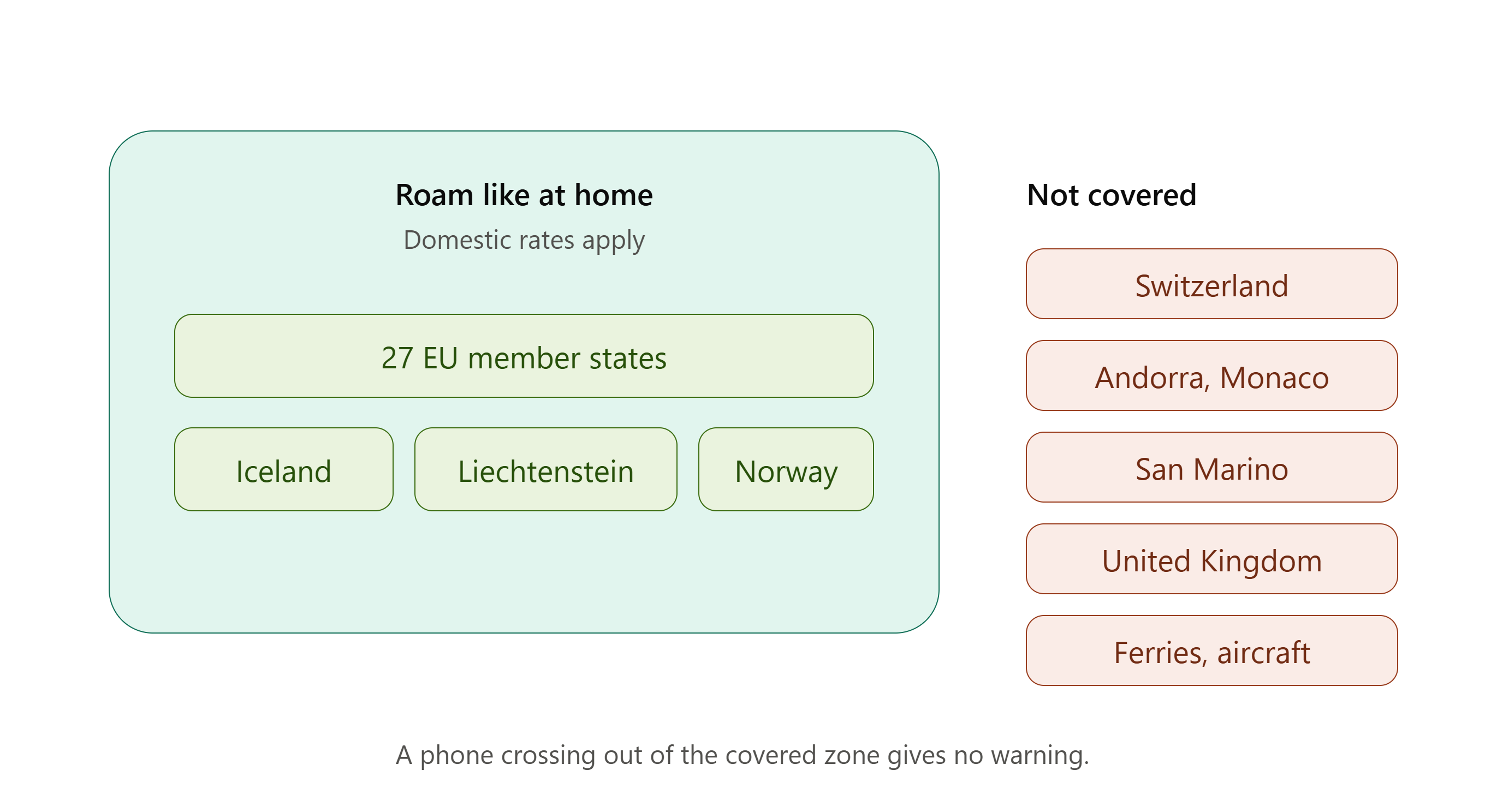
Roam Like at Home applies to the 27 EU member states plus Iceland, Liechtenstein, and Norway, which belong to the European Economic Area. Within that area, a subscriber uses their domestic allowance at domestic prices: outgoing calls, outgoing SMS, and mobile data are billed exactly as they would be at home, with no roaming surcharge.
The 2022 extension added two obligations. Operators must provide the same quality of service abroad as at home where the visited network supports it, meaning a customer with 5G access at home should get 5G abroad rather than being pushed onto 3G. And access to emergency services, including caller location, must work under the same conditions everywhere in the area.
What is not included
Three exclusions cause nearly all the confusion.
Calls made from your home country to another EU country are international calls, not roaming. A person in Germany phoning a number in Spain pays international rates, not domestic ones. Roaming applies only when you are physically abroad.
Calls to non-geographic numbers stay outside the rule. Premium numbers, directory enquiries, and some service lines are billed separately regardless of where you are.
Several European territories are outside the EEA and therefore outside the regulation. Switzerland, Andorra, Monaco, San Marino, the United Kingdom, Turkey, and the Western Balkans are not covered. naked.net explicitly lists Andorra, Monaco, San Marino, and Switzerland as destinations where additional charges apply to calls and mobile data.
| Situation | Covered by Roam Like at Home | What you pay |
|---|---|---|
| In France, calling a French number | Yes | Domestic rate |
| In France, calling your home country | Yes | Domestic rate |
| In France, using mobile data | Yes | Counts against domestic allowance |
| In France, receiving a call | Yes | Same as at home |
| At home, calling a French number | No | International call rate |
| In Switzerland, any usage | No | Operator roaming rate for Switzerland |
| In the UK, any usage | No | Operator roaming rate for the UK |
| On a ferry or aircraft | No | Satellite or maritime network rates, often very high |
The last row deserves attention. Ships and aircraft use onboard base stations connected by satellite. These carry their own network codes and are not part of any national network, so the regulation does not reach them. A phone left with data roaming enabled on a Baltic ferry can register to the onboard network within sight of the coast and generate charges that bear no relation to domestic pricing.
Fair use and the limits that still exist
Roam Like at Home was written for travel, not for permanent use of a foreign SIM. Two mechanisms enforce that.
The stable link test
Operators may check that a customer has a genuine connection to the country where the plan was bought. If usage is predominantly abroad over a rolling four-month window, both in days present and in volume consumed, the operator may ask for evidence of a stable link and, failing that, apply a surcharge. The surcharge is capped by regulation and is far below pre-2017 roaming rates.
In practice this affects people who buy a SIM in one country and live in another. Ordinary holidays, business trips, and even a month-long stay do not trigger it.
Data volume limits on unlimited plans
A plan advertised as unlimited at home does not automatically carry unlimited data abroad. Operators may apply a fair use volume derived from a formula based on the plan price and a regulated wholesale cap. Beyond that volume, a small per-gigabyte surcharge applies for the rest of the billing period.
Plans with a defined data allowance are simpler: the full allowance is usable abroad, and once exhausted, standard domestic out-of-bundle rates apply.
The cost cap on data
A safeguard applies across the EU: once roaming data charges reach 50 euros excluding VAT in a billing period, the operator must stop the session and require explicit confirmation before continuing. Customers receive a warning at 80 percent of the limit. This cap applies to roaming outside the EEA as well, which is the single most useful protection for travel to countries where the regulation does not apply.
Planning a trip: a worked example
A two-week trip from Germany with stops in Austria, Switzerland, and Italy, driving between them. The Swiss leg is where the cost sits.
- Check which destinations fall outside the EEA. In this itinerary, Switzerland does. Austria and Italy are covered.
- Look up the per-country roaming rates for the uncovered destination in the provider's price list or roaming calculator. naked.net provides a roaming calculator that estimates costs by country and indicates whether a roaming package is worth booking.
- Estimate Swiss usage separately: how many days, how much navigation, how many calls. Navigation is the largest driver on a driving trip, roughly 5 to 10 MB per hour with map data cached.
- Download offline maps for the Swiss section before departure. This single step removes most of the data need for navigation.
- On crossing into Switzerland, either accept the roaming rates or turn data roaming off and rely on Wi-Fi at hotels. If you turn it off, do so in settings rather than by enabling airplane mode, so calls and SMS still work.
- Watch for the border effect. In Konstanz, Basel, and along the Italian-Swiss lakes, the strongest signal is frequently the network on the other side of the border. Set network selection to manual and pick a domestic operator when standing within a few kilometres of an uncovered country.
- After returning, check the itemised bill for the Swiss days specifically. Charges from a border overlap show up as roaming on days when you never left the covered area.
Step six is the one most travellers skip and the one that produces the strangest bills. Automatic network selection optimises for signal strength, not for price.
Practical points that change the bill
- Voicemail retrieval abroad may be charged as an outgoing call to your home country. Disable voicemail before a trip if you do not need it.
- Incoming calls are free under the regulation, but a call diverted to voicemail is treated as an outgoing leg by some operators.
- Messaging apps over data avoid call charges entirely, including in countries outside the regulation, as long as data itself is affordable there.
- Wi-Fi calling routes calls over the internet using your home number. Where the operator supports it abroad, it removes roaming from the equation for voice.
- Background data does not pause at borders. Cloud photo backup running on a Swiss motorway is billed at Swiss roaming rates, not domestic ones.
- Dual SIM devices can hold a local data profile alongside the home number, keeping the home line for calls and SMS while data runs on a cheaper local plan.
FAQs
Does Roam Like at Home cover the United Kingdom?
No. The UK left the EU and is outside the EEA, so the regulation no longer applies. Some operators voluntarily include the UK in their roaming zone at domestic rates and others charge separately. Check the country list in your tariff documents rather than assuming.
Why was I charged for roaming when I never left my own country?
Border overlap. Networks do not stop at national frontiers, and a phone near a border can register to a foreign network offering a stronger signal. Setting network selection to manual and choosing a domestic operator prevents this.
Is there a limit on how long I can use my phone abroad?
There is no fixed day limit. Operators apply a fair use assessment over a rolling four-month period, comparing time spent abroad against time at home and volume used abroad against domestic volume. Predominant use abroad may trigger a request for evidence of a stable link to the home country, followed by a regulated surcharge.
Does my unlimited data plan give me unlimited data abroad?
Not necessarily. Operators may apply a fair use volume calculated from the plan price and a regulated wholesale rate. Above that volume, a capped per-gigabyte charge applies for the remainder of the billing period.
What happens when I reach the 50 euro data cap?
The operator must interrupt the data session and obtain explicit confirmation before allowing further charges. A warning is sent at 80 percent of the limit. The cap applies worldwide, not only within the EEA, which makes it the main safeguard on trips outside Europe.
Do calls to other EU countries from home count as roaming?
No. They are international calls and are priced separately. EU rules cap them at 19 cents per minute for calls and 6 cents per SMS excluding VAT, but that is a different regulation and a different price from your domestic rate.
Conclusion
Roam Like at Home solves the problem it was designed to solve: using your normal plan in another EEA country at normal prices, without preparation. For a holiday in Spain, Italy, or Croatia, there is nothing to configure and nothing to book.
The money is lost at the edges of the rule. Switzerland, Andorra, Monaco, San Marino, the UK, ferries, and aircraft sit outside it, and a phone does not announce when it crosses that line. Border regions compound the problem by attaching to whichever network is strongest.
Two habits cover almost all of it. Check the country list in your tariff before you travel, and switch network selection to manual whenever you are near a border with a country the regulation does not reach. A roaming calculator that estimates cost per destination turns the remaining uncertainty into a number you can decide on before departure rather than read on a bill afterwards.